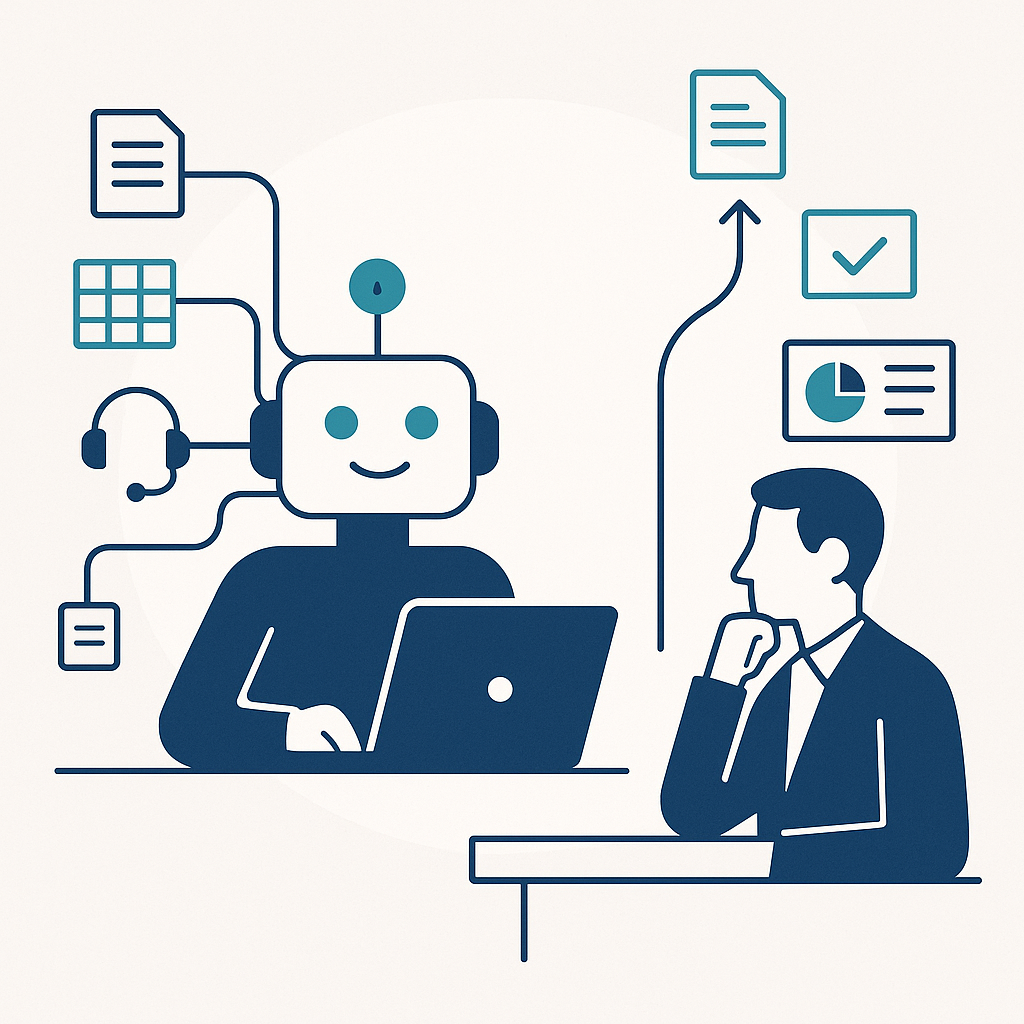
A digital employee makes the most sense when a company needs a specific function but does not want or cannot afford to hire another person for it. This could mean regular financial analysis, sales research, handling repetitive support requests, or analyzing customer conversations.
This is not about launching another chatbot. A digital employee needs to be designed for a specific organization, integrated into its processes and systems, and given a clearly defined scope of responsibility and escalation rules. In practice, it is an AI implementation project, described in terms of a role and responsibilities rather than models, agents, and technical architecture.
Ten artykuł jest dostępny także po polsku: Cyfrowy pracownik.
What exactly is a digital employee?
A digital employee is an AI agent designed to perform a defined set of tasks within a specific company.
In that sense, it resembles a regular employee. It has a job description, access to the systems it needs, operating rules, performance metrics, and a manager. It should also know where its authority ends and when a case needs to be handed over to a human.
That is what separates it from a general-purpose chatbot. A universal model can do many things, but it does not automatically understand how a particular company works. A digital employee is configured for a specific role and organization.
During implementation, we define:
- which tasks it is responsible for;
- which data and systems it can access;
- which standards it should follow;
- which actions it can take independently;
- when it should escalate to a human;
- how its performance will be measured.
Where can a digital employee work well?
The best starting point is usually a process with a lot of repetitive work, a clearly defined expected outcome, and enough human oversight to keep the system under control.
Digital financial controller
Imagine a company that is still too small to hire a financial controller for PLN 25,000–30,000 per month, but already needs much better visibility into its finances.
A digital controller can be connected to the company’s accounting and financial systems and work according to a defined schedule. It can:
- analyze financial data;
- monitor liquidity and selected KPIs;
- prepare forecasts;
- provide the owner or CFO with a daily or weekly report.
In the example we use in conversations with clients, a digital financial controller could cost around PLN 2,000–3,000 per month instead of the full cost of hiring a specialist.
Digital sales researcher
Sales research is necessary before running outbound campaigns, but it is often difficult to justify hiring someone whose sole responsibility is to search for companies, check profiles, and collect contact data every day.
As a result, this work is usually done by sales or pre-sales teams, even though they could be spending that time on tasks that actually require human interaction.
A digital researcher can:
- find companies that match the ICP;
- verify them across different sources;
- identify relevant decision-makers;
- enrich contact data;
- pass ready-to-use records to the sales team.
It can, for example, prepare 50–100 pre-qualified companies per day.
At ITSG, we already use this type of solution internally. It is a good example of a function that would probably never have justified a dedicated full-time role in the first place.
Digital customer service employee
A large share of customer service requests concern standard issues: case status, product rules, procedures, or information already available in internal documentation.
A digital employee can handle these cases independently. But if a request goes beyond its knowledge or requires a non-standard decision, it should hand the case over to a human.
That is why a digital employee needs a manager. A human handles escalations, reviews performance, and monitors quality.
Digital conversation analyst
With a high volume of sales or call center conversations, manually reviewing recordings quickly stops being practical.
A digital analyst can:
- transcribe and analyze conversations;
- identify recurring questions, objections, and problems;
- detect patterns;
- prepare reports for managers;
- provide material for team coaching.
We already use this type of solution at ITSG. It does not replace the manager, but it gives them access to insights they would not be able to collect manually at the same scale.
A digital employee is a regular AI implementation project
This is an important part of the conversation about AI agents that often gets overlooked. A digital employee has to be built and implemented first.
You do not choose a language model, write one prompt, and have a working digital controller or researcher the next day.
At ITSG, we start with the process and the role. We need to establish:
- what people currently do manually;
- which responsibilities can be handed over to AI;
- which data the system needs;
- which systems it must access;
- where its autonomy should end;
- when a human decision is required.
Only then does the technical work begin.
From job description to working solution
Depending on the use case, the project may involve integrations with a CRM, accounting software, databases, internal documentation, or communication tools.
Next comes the operating logic: instructions, rules, access to knowledge, the way AI models are used, and escalation paths.
Then we test the system. Not only on standard cases, but also on situations where data is missing or an unusual scenario appears.
Only once the system behaves predictably enough should it become part of normal business operations.
ITSG can design, build, and implement this kind of digital role – including integrations, operating rules, testing, and oversight. The goal is not to sell access to an AI model, but to build a solution for a specific business process.
A digital employee still needs a manager
Implementation does not end when the system goes live.
The work of a digital employee needs to remain auditable. We should be able to see what it did, what the outcome was, and when it escalated a case to a human.
The manager on the company side is responsible for:
- reviewing results;
- handling escalations;
- monitoring quality;
- making decisions the system should not make independently.
ITSG can handle the technical side of maintenance: monitoring, knowledge updates, changes to instructions and rules, and adapting the system when business processes change.
New product? Updated procedure? New way of handling a particular case? The digital employee needs to be updated too.
How much does a digital employee cost?
There is no single price because the cost depends on the scope of responsibilities, number of integrations, and intensity of use.
The main components include:
- AI model usage, including token costs;
- infrastructure and API access;
- system integrations;
- monitoring and maintenance;
- updates and further development.
In the examples we are currently working with, the monthly cost of a digital employee can start from PLN 2,000 depending on complexity.
These figures should not be treated as a universal price list. A system generating a few reports per week will have a very different cost profile from an agent performing many operations every day across several systems.
The most interesting case: a role that did not exist before
Digital employees do not have to replace existing jobs.
Sometimes the more interesting scenario is that the company starts doing work that nobody had been doing systematically before.
A small business is unlikely to hire a dedicated conversation analyst. Salespeople will rarely get their own researcher. An owner may not be ready to hire a financial controller for tens of thousands of złoty per month.
But the need is still there.
The work is either ignored or done “on the side” by people who already have a full workload.
A digital employee lowers the entry barrier and makes it possible to create a function that makes business sense but would never justify a full-time position.
When does a digital employee make sense?
Not every role can or should be turned into a digital employee.
The best candidates are tasks that are:
- repetitive;
- possible to describe with clear rules;
- data-driven;
- performed at scale;
- tied to a clearly defined outcome.
Good examples include document analysis, report generation, research, preparing proposals based on defined inputs, or handling standard customer requests.
It becomes much harder when the work depends on years of experience, intuition, creativity, or relationships built on a high level of trust.
So the boundary does not always run between entire job titles. More often, it runs within the role itself.
A salesperson still leads the conversation, but AI can do the research. A manager still runs the team, but does not need to manually review hundreds of calls. A CFO still makes decisions, but part of the analysis can be handled by the system.
Security, auditability, and escalation are not optional
If a digital employee has access to company data and can take real actions inside business systems, security needs to be part of the project from day one.
Three principles are especially important:
- minimum necessary permissions – the system only gets access to what it actually needs;
- auditability – actions are logged and can be reviewed later;
- clear limits of autonomy – the system knows when it must hand a case over to a human.
If the digital employee does not know something, it should not guess.
That is one reason why it is more useful to think about it as an employee with a defined scope of competence rather than “AI that can do everything.”
It is also an organizational change
Even a well-designed system will not work if the company does not know how to use it.
The team needs to understand:
- which tasks can be delegated to the digital employee;
- what to do with its outputs;
- how to respond to escalations;
- who is responsible for quality control.
Sometimes the implementation also changes the workflow itself. If someone previously copied data manually between two systems, that step may disappear or become automated.
That is why we treat a digital employee as a process and technology implementation, not as another software purchase.
Will digital employees replace people?
We do not know how far automation will go over the next few years. What is already clear, however, is that many repetitive tasks based on data and rules can now be handled differently.
That does not necessarily mean entire jobs will disappear. More often, the structure of those jobs will change.
A salesperson still builds the relationship, but does not spend two hours doing research. A call center manager still leads the team, but does not manually listen to a random sample of calls. A business owner still makes financial decisions, but does not need to collect data manually from several spreadsheets.
So instead of asking, “Which people will AI replace?”, a better question is:
Which tasks are people in our organization still doing simply because, until now, there was no sensible alternative?
A digital employee starts with a specific problem
We do not have one type of company to which we automatically recommend a digital employee. The problem matters more than the company profile.
Is there a necessary function in the organization that nobody currently performs? Are specialists spending a large part of their day on repetitive, clearly defined tasks? Does the company need a particular capability, but a full-time position would not make economic sense?
If the answer is yes, it is worth checking whether that scope of work can become a role for AI.
At ITSG, we can analyze the process, design the digital employee, integrate it with your systems, and implement it into day-to-day operations. If you have a task or function that looks like a good candidate, talk to our team and we can assess whether it can be automated in a practical and reliable way.