
If you had been running your company for a while, you might have lost track of your own architecture. Whatever you’ve been using was transformed so many times by your employees that at this point its original shape could be long gone and although it’s not really visible it definitely is affecting how your clients are served.
Of course, one can always build a new architecture entirely from scratch, but it would be a massive investment, that’s going to make your employees frustrated at first (since the current version is working) and before it’s fully implemented clients might not be happy about it as well.
Conducting an architecture audit first is going to be more profitable and, what’s more, it’s going to help you determine the strengths and weaknesses in your system.
The process goes as seen below:
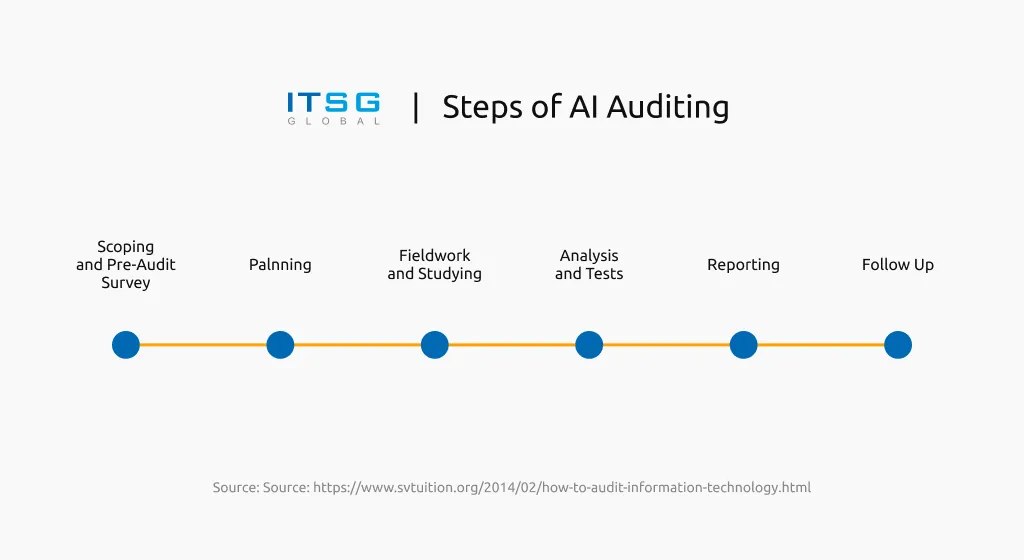
In order to get a clear picture of the subject, you need to prepare a full inventory of your software and figure out the workflow between applications. The point of this step of the audit is to understand the logic of your architecture. Keep in mind, that your employees might suggest that the current system is acceptable because they’ve learned by heart how to navigate it, so they don’t see how effective it actually is - they simply don’t have any comparison.
After the first step, it’s possible to see:
-
Redundancies - that is those of the functionalities that are not being used and there might be no need to support them
-
Places for development - understood as areas, where it would be nice to actually have more features to provide specific information on the process
KNOW YOUR PROCESSES
If your organization has grown (which is a good thing, obviously) and over time you hired more people it has automatically increased the number of processes whether you’ve acknowledged that or not. That being said, even if your company uses the same software as 10 years ago, you might not even be aware of how many other applications are being used by your employees without your knowledge or approval. It’s a security issue as well since you have no control over how your client’s and company’s data is being processed.
The point is, that your architecture, ideally, should cover three types of operations.
-
Operational process - that’s probably what the majority of your employees are taking care of and simultaneously it’s the primary value stream of your business. It’s the software responsible for taking and processing orders, managing manufacturing operations, and so on. It should be easy to navigate by all employees engaged in each process, but also clear and user-friendly for your clients (if they have access to it)
-
Management process - this is the part that’s often underestimated, especially if the business started as a small one. Over time, as the organization grows its own hierarchical structure, more managers and team leaders appear and it’s beneficial to have “a place” in the software for them to manage there as well. Features responsible for generating reports and seeing if processes are completed bring real value to the customer experience and improve communication within the organization
-
Supporting process - such as accounting, legal matters, or recruitment processes, that ensure that the whole organization is being run correctly
At this point, we might be dealing with a legacy issue.
LEGACY SYSTEMS AND PRIORITIZATION
A legacy system is software that has been used for so long that it has become outdated. Its maintenance is expensive, but companies choose to keep them because they’re afraid of the cost of investing in a new one. Documentation (or lack of such) may also pose a challenge if the authors of the original concept are not available anymore.
A well-prepared audit will provide you with information, on whether your legacy system can be modernized or if it’s better to implement a new solution.
At this point, the auditor might have some suggestions about which of the processes might give an actual competitive advantage if improved. It’s a space for discussion on how much value is actually delivered through different processes and from where the investment should begin.
WHAT SUMMARIZES THE AUDIT
The audit will provide you with specific information on your architecture and its state, including security factors. Conclusions and recommendations should be supported by collected evidence. It’s important to obtain full documentation and reports from the audit, usually on executed operations and chosen methodology. Finally, findings should be explained to the organization’s representative, so appropriate steps can be taken in the future.
Author: Andrzej Wodnicki, Managing Director at ITSG Global