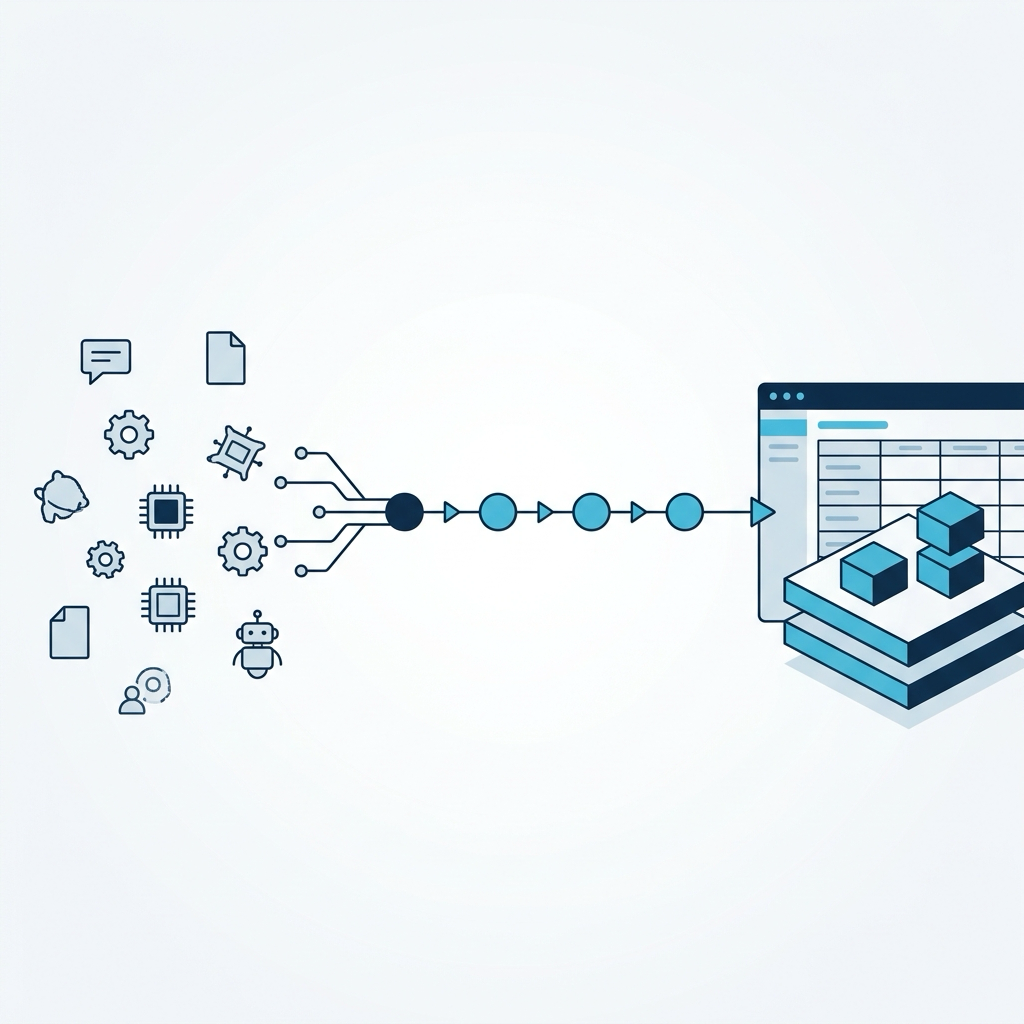
The B2B artificial intelligence market looks a lot like the Wild West right now. On one side, you have companies that have hired a technical specialist or where a co-founder is experimenting with AI tools on their own. On the other side, you have organizations stuck in fear, doing little more than using ChatGPT from time to time.
The problem is that both groups rarely see real business value.
Why? Because implementing AI in a company is not mainly a technology challenge. It is an organizational process. In this article, we will show a proven methodology that helps companies move from isolated experiments to solutions that work across the whole organization - with measurable impact on sales and operational efficiency.
Two Worlds: Companies That Are Just Starting and Companies That Have Already Tried
Clients Who Are “Doing Something”
The first group includes organizations where leadership has decided that “we need to do something with AI” and hired a technical lead. In smaller companies, this role is often taken by a tech-minded co-founder.
More and more advanced AI agents start appearing. One client recently described how an agent he built himself processed data faster and helped win new customers. It was an impressive personal achievement, but also a perfect illustration of the main problem in this group.
The biggest barrier is moving from “I built something for myself” to “the whole organization can use this.” These internal proofs of concept rarely scale across broader processes, user groups, roles, or permission levels. What is missing is a wider perspective - an approach that identifies the best isolated ideas and turns them into solutions that serve the entire company.
Clients Who Have Not Started Yet
The second group includes companies still in the exploration stage. They have heard about AI, they are thinking about it, but they are paralyzed by uncertainty. At most, a few people are experimenting with a chatbot unofficially, without leadership even knowing.
Here, the key is to break through two barriers: education and trust. Only when the organization understands what is possible and sees a safe path to implementation does it become ready to act.
And importantly, in every company like this, there is already someone who is “trying things out.” You just need to find that person.
Why “Everyone Doing Their Own Thing” Does Not Deliver Results
The number of articles saying “AI is great, but we are not seeing the benefits” keeps growing. We can see exactly why this happens.
The problem is not the technology itself. The problem is fragmentation. When every department or internal enthusiast builds their own solution - without coordination, shared data, or governance - the result is a patchwork of incompatible tools.
Efficiency may improve locally, if at all, but it does not translate into P&L impact.
Organizational AI implementation requires:
- a shared vision - which business problems are we solving;
- shared data - one source of truth, available to agents according to access rights;
- governance - who decides on priorities, who is responsible for security, and who measures ROI.
Without this, you get chaos: hundreds of hours of work and no scalable results.
A Proven Methodology: Four Stages of AI Implementation in Business
We have tested an approach that turns chaos into a controlled process. It consists of four stages, each with a specific business goal.
Stage 1: Inspiration Workshop With Leadership
The first session is not a slide presentation. It is a conversation about specific opportunities, based on experience from different markets.
We show use cases matched to the client’s industry and internal processes. The goal is to jointly identify the areas where AI implementation can bring the highest operational return.
Key questions we ask:
- Which processes are currently bottlenecks?
- Where do you lose time on low-value manual work?
- Which areas have the biggest impact on P&L and can be measured quickly?
Stage 2: Discovery - Finding the Hidden Gems
After the workshop, we sit down with the people who have already experimented with AI or who know the internal processes inside out.
This is a one-day or two-day discovery phase in which we:
- collect all ideas - from wild concepts to mature initiatives;
- assess them based on organizational readiness, process maturity, and AI’s technical capabilities;
- prioritize them - selecting 2-3 initiatives with the highest ROI potential and the lowest implementation risk.
This is the moment when chaos turns into a roadmap. Dependencies become visible: which data needs to be prepared, which access rights need to be configured, and which integrations are necessary.
Stage 3: Pilot - Proof of Value
We select 2-3 priorities and pilot them over one or two months.
This is not a proof of concept, meaning “let’s check if it works technically.” It is a proof of value, meaning “what business value does this actually bring?”
We measure specific metrics:
- Does the process become faster? By what percentage?
- Does conversion or output quality improve?
- Do employees actually use the solution, or do they work around it?
The pilot is also the moment to test assumptions. Some ideas turn out to be less effective than expected. It is much better to learn this on a small scale before AI implementation starts consuming the budgets of entire departments.
Stage 4: Production Implementation on the Platform
Only now do we move to scaling.
We embed the solutions on the Cortex platform, which provides:
- Roles and permissions - who has access to which data and functions.
- Security - isolation of sensitive information, AI activity audits, and GDPR compliance.
- Access to multiple models - the organization does not become dependent on a single LLM provider.
This is the point where you can say that the organization is truly on the AI side, not just “playing with AI.”
And only now do real, measurable benefits begin to appear across the company.
When the Company Has Not Started Yet: Education as the Foundation
For organizations still in the exploration phase, the process looks very similar, with one key difference: between the inspiration workshop and discovery, we add team training.
The goal of the training is to:
- show what AI can and cannot do, clearing up common myths;
- teach the basics of prompting and working with agents;
- identify internal enthusiasts - the people who have already tried something or have an appetite for experimentation.
Leadership gains trust when it sees that the team is engaged rather than threatened.
Most importantly, hidden talent starts to surface: someone in operations who automated reporting on their own, or someone in customer service who built a chatbot for FAQs.
Every company has people like this. They just need to be found and given structure.
Two Reactions After the Workshop: Excitement and Fear
After every inspiration workshop, we see a clear split.
Group 1: The Excited Ones
“The world will move past us if we do not do this. It is not a question of whether, but when and how.”
They want the next stages: discovery, proof of concept, implementation. Ideally tomorrow.
These are the people who understand that AI is not a trend. It is a competitive advantage. And the sooner they start, the stronger the moat they can build against competitors.
Group 2: The Frightened Ones
“I do not understand any of this. I will have to learn everything from scratch. I am afraid AI will expose customer data. Or make a mistake that we will have to pay for.”
These concerns are completely valid. And it is good that they are expressed, because they can be addressed.
Key solutions include:
- Data security: Separation of sensitive data, encryption, and access audits. Not every agent needs access to everything. Permissions are assigned just like in an ERP system.
- Quality control: Human-in-the-loop workflows for critical decisions. The agent makes a recommendation, the human approves it.
- Step-by-step education: Role-based training. Not everyone needs to become an AI engineer. What matters is that people know how to use the tools safely.
The conclusion: both reactions are right. There are solutions to these concerns, but you need to know how to approach the process.
And this brings us back to the four-stage methodology: education, discovery, pilot, and implementation. Each step addresses specific concerns and builds trust.
Rising AI Costs: Why Dependence on One Provider Is a Risk
Few people say this out loud, but current ChatGPT, Claude, and Gemini subscriptions are subsidized. LLM providers are fighting for market share, so they subsidize prices.
The real cost of token processing is higher. Sooner or later, companies will stop covering that difference.
What does this mean for the client?
Imagine that you have built critical processes around one LLM provider. Suddenly, the price increases fivefold. This is not science fiction. We have already seen similar price jumps in other cloud services.
The benefits you have created now flow to the provider. And switching to another model? If your solution is tightly connected to one provider’s API, refactoring becomes expensive and time-consuming.
The Cortex Platform: Independence From a Single LLM
That is why, as part of AI implementation in a company, we use an architecture that makes it easy to switch between providers.
Think of it like this: you build a factory assuming that you will have electricity. But in the energy market, you can change suppliers because regulations and standards are unified.
In the LLM market, there is no such protection. If you tie yourself to one provider and that provider raises prices, you have a problem.
Cortex solves this by making sure that:
- agents and automations use a unified interface;
- you can switch models, for example from OpenAI to Anthropic, Gemini, or your own open-source model, without rewriting the logic;
- you control costs and avoid becoming locked into one provider.
Open Source as Insurance
Open-source models are also maturing quickly.
For many use cases, such as classification, data extraction, or simple generation, they are already good enough. They can also be hosted in your own infrastructure.
You can think about this like energy. For some processes, you build your own solar farm, meaning an open-source model. For others, you buy from an external provider, meaning a commercial LLM.
This gives you control over unit cost and prevents your IT budget from depending on the pricing decisions of one company.
FAQ: Common Questions About AI Implementation in Business
Do We Need Our Own Data Scientist to Implement AI?
No. Most solutions today are based on ready-made models, such as LLMs or classifiers.
You need someone technical for integrations and APIs, but you do not need to build models from scratch. If you have processes that require custom machine learning, then yes, you may need that capability. But this is a minority of cases.
How Do We Ensure Data Security?
Through architecture: separated environments, encryption, roles and permissions, and audits.
Sensitive data, such as personal data or contracts, can be processed only in an on-premise environment or private cloud, without being sent to publicly available APIs.
What If AI Makes a Mistake?
This is why we use human-in-the-loop workflows for critical decisions.
The agent makes a recommendation, the human approves it. As trust grows and the data improves, you can increase AI autonomy, but always with auditability in place.
Will AI Replace My Employees?
AI replaces tasks, not roles.
Employees gain time for higher-value work: strategy, relationships, and creativity. We see this in real cases. Teams become smaller but more productive, or the same team can handle a larger volume of work.
Summary: From Chaos to Controlled Implementation
AI implementation in business is not just a technology project. It is an organizational project.
Companies that succeed have several things in common:
- A clear vision: Which business problems are we solving, and which KPIs are we measuring?
- A structured process: Workshop, discovery, pilot, production.
- Governance: Roles, security, and independence from a single provider.
- Team engagement: Education, enthusiasts as ambassadors, and human-in-the-loop workflows.
Chaos, where everyone is doing their own thing, does not deliver results.
A controlled process does.
And the data confirms it: clients that go through the full cycle see higher efficiency in automated areas and shorter completion times for key processes.
Ready to Implement AI the Right Way?
Moving from scattered experiments to AI that works across your whole organization starts with a single conversation. We guide companies through the full cycle - inspiration workshop, discovery, pilot, and production deployment on the Cortex platform.
Talk to our team about where your organization should start.